Showing posts with label Pleco. Show all posts

Friday, September 16, 2016

Nursery Rhyme

Kids can learn language from singing. For me, when I teach a song, I make sure that the kids know what it means. I will go through the lyrics line by line with them. Say the lyrics and translate it. Then I will repeat explaining the whole song again and again. This cannot be done just once. You have to repeat it over and over again.

I also make sure that I correct them when they pronounce a word in the lyrics wrongly. For me, it is how they learn the language properly.

Here I would like to introduce one of Popular Chinese Nursery Rhyme. Play the song for your kids, as for yourselves, you can try to translate what the song is saying. And then translate it to them. Here is the lyric:

Title: 我  的  朋友     在  哪里?
          Wǒ de péngyǒu zài nǎli?


First Part:
一 二 三 四 五 六 七,
Yī èr sān sì wǔ liù qī

我  的  朋友      在 哪里?
Wǒ de péngyǒu zài nǎli?

在   这里,在 这里
Zài zhèlǐ, Zài zhèlǐ

我   的  朋友    在   这里
Wǒ de péngyoǔ zài zhèlǐ

Second Part:
啦啦啦啦    真   欢喜
Lā lā lā la zhēn huānxǐ

同       唱歌     来  同    游戏
Tóng chànggē lái tóng yóuxì

笑 嘻嘻,多 甜蜜
Xiao xīxī duō tiánmì

我   的   朋友    就是  你
Wǒ de péngyǒu jiùshì nǐ


Here is the song:

This video is downloaded from youtube. Here is the link.

Happy Singing,
Linda Tan

Friday, August 5, 2016

Answers to Lesson 6

In Lesson 6, we learn about telling day and date. There are some exercises given at the end of the post. Check your answer here:

1. What date is the day after tomorrow?
hòu tiān shì jǐ hào?

2. The day after tomorrow is August the 4th
hòu tiān shì bā yuè sì hào

3. What day is yesterday?
 zuó tiān xīng qī jǐ?

4. Yesterday is Sunday
zuó tiān (shì) xīng qī rì

5. What date and month is 2 days ago?
qián tiān shì jǐ yuè jǐ hào?

6. 2 days ago was 31st of July
qián tiān shì qī yuè sān shí yī hào


Listen to the following


Practice it everyday! Wake up in the morning and tell yourselves that:
Today is Monday, Yesterday is Sunday, Tomorrow is Tuesday, 2 days ago is Saturday, and the day after tomorrow is Wednesday.

Also... Today is Aug 2nd, Tomorrow is Aug 3rd, Yesterday is Aug 1st, and so on...

It will not take long, do it while you are showering, etc... In a month time, you will be very fluent in asking and telling day and date as well as in numbers! :)

Happy Weekend,
Linda Tan


Saturday, July 9, 2016

Weekend Reminder

Hi learners,

Have you master hanyu pinyin, the Chinese phonics? You will need it to be able to master all the lessons that I am going to share.

If you haven't, please visit the pinyin post. Take it slow but sure!

OR...

Have you got to know what are the tools that might be useful to assist you in your learning journey?

If you haven't, please read about the assistants that you need in learning Chinese.

Grasp the two basic above before rushing to learn more things.

Don't worry, the post is not going anywhere. You just have to be committed enough to spare sometimes on each post and discipline enough to do it regularly.

To not miss any post in the future, subscribe via email to get each post in your inbox.

Happy Weekend,
Linda Tan

Thursday, July 7, 2016

Lesson 1: Basic Numbers (A)

For me, teaching Chinese for adults and kids are different. The way of teaching is definitely different, the order of things that I teach is different too. I have the background for both, but coming from a city where Mandarin is something common and nothing exclusive, I used to have high expectation to the learners. Moving to Bali, I have to lower my expectation towards the learners (both kids and adults) and slow down my pace of teaching.
For every coming post in the future I am going to label them “Chinese for Adults” and “Chinese for Children”. Also, I will put (A) for adults and (C) for children within the title. So, you can refer to the relevant posts easily.
Today, I am going to start the lesson for adult. Like language in general, we start from numbers!

Zero - Ten in Chinese

Here is the basic numbers 1 – 10, in Chinese
一   yī             One (1)
二   èr            Two (2)
三   sān         Three (3)
四   sì             Four (4)
五   wǔ          Five (5)
六   liù           Six (6)
七   qī            Seven (7)
八   bā           Eight (8)
九   jiǔ           Nine (9)
十   shí          Ten (10)
Apply your knowledge on the Chinese phonics here (from now on, you will get to practice that often!). If you need help to confirm the pronunciation, key in the pinyin above and look for the correct character on Pleco and listen to the pronunciation.
Get a hold of 1 - 10 above,  Master them first, before continuing. Moving on I would like to introduce 10 - 100 to you, that comes in exercise. Try your very best not to peek the above. You must be able to recall "nine" as "jiǔ", "six" as "liù", and so on without referring to your note...
Let's start:
十一     shíyī           Eleven (11)
十二     shíèr           Twelve (12)
十三     shísān         Thirteen (13)

十四     shísì            Fourteen (14)

:           :                    :
二十     èrshí            Twenty (20)
Can you see the pattern above?


Exercise 1: I want you to fill the missing numbers between 14 - 20

Answer can be jotted down in the following 3 ways:
1 . You say it and record it down with your phone, so that you can check your answer later on and also this allows you to compare your pronunciation to the correct pronunciation, OR
2. You can write down the pinyin, to practice on your hanyu pinyin (the phonics), OR
3. You can write down the Chinese characters, if you wish to learn to write and read the Chinese characters, remember there is order of strokes that you have to follow, check this on bihua site. If you have forgotten how to use the site please refer to the previous post, OR
4. You can do 1, 2, and 3 all together
Finish the above before continuing... You can stop if you think you have enough for this one session and continue the following later.

Moving on. The last number that we learnt was 二十 (èr shí) Twenty (20)
二十一        èr shí yī        Twenty one  (21)
二十二        èr shí èr        Twenty two (22)
二十三        èr shí sān      Twenty three (23)
     :                   :                  :
三十            sān shí yī        Thirty (30)
三十一        sān shí èr        Thirty one (31)
:                      :                    :
四十            sì shí               Forty (40)
五十            wǔ shí             Fifty (50)
六十            liù shí              Sixty (60)
 :                      :                    :
 :                      :                    :
九十             jiǔ shí              Ninety (90)
 :                      :                    :
一百             yī bǎi               One hundred (100)

As you can see there are many missing numbers from 23 - 100.
Exercise 2: Please fill in the missing numbers by looking at the pattern from the numbers that are shown. Numbers in Chinese is quite easy no changes in writing or whatsoever like in English (forty not fourty, twelve not twoteen, thirty not threety, and so on).
Answers to be revealed in a separate post!

Please Note: 
In Chinese, the number "2" that is usually written as "二" and read as "èr" will change to 两 (liǎng) whenever it it is used to measure things, like 2kg (weight), 2 o'clock (time), 2 dollars (money), etc.
We say:
2 kg            两公斤       liǎng gōng jīn
2 o'clock     两点           liǎng diǎn
2 dollars     两块            liǎng kuài

Happy Numbering!
Linda Tan

P.S. For your knowledge
Pinyin should be written without space if they are one phrase.
For example: gōng jīn means kilogram. It is ONE word in English and it represented with 2 Chinese characters, they are gōng and jīn, thus, gōngjīn is supposed to be written WITHOUT space. However, for easy reading for beginner, I would like to separate all the pinyin from one another.


Monday, July 4, 2016

Hanyu Pinyin - Part 4 - More Phonics

 Here are the phonics that you have been introduced before:
Single vowels: a, o, e, i, u, ü and
Consonants: b, p, m, f, d, t, n, l, g, k, h, j, q, x, zh, ch, sh, r, z, c, s, y, w

Other than the above, there a few more that you have to know and understand. As you can already see in the pinyin chart on Yabla's site, there are many of the remaining that I haven't covered. In fact, I am not going to cover all. I will show you the other basic pinyin that is formed by combining the 2 vowels, that is known as 双韵母 (shuāngyǜnmǔ) and sounds that come out from your nostril, known as 鼻韵母 (bíyǜnmǔ )

Let's first look at 双韵母 (Shuāngyǜnmǔ). It literally means double vowels. Here they are:
ai    ei    ui   
ao   ou
iu    ie    üe    er

Tips on pronouncing the above:
1. Pronounce the first alphabet (remember it is more to Bahasa Indonesia ABC than English ABC) and without stopping (no gap), followed by the pronunciation of the second alphabet.

2. Repeat the sound in a faster pace.

3. Again, it sounds almost the same like Bahasa Indonesia pronunciation. You do not have to memorize them all. Just try to pronounce it with the trick above (no. 1 & 2) and you should be able to get the correct pronunciation. Again, NO memorizing)

Let's see the video below (I am sorry, that you can only view this on your desktop).

Here is the implementation in spelling a word:

Remember! The spelling of the 2 vowels must be pronounce continuously without stopping. Treat "ao", "ei" as One phonic, not 2 separate phonics. Here is the difference if you spell it one by one with a gap in between, and this is not the right way to do it!


Here is how you use it in spelling a word!


More Example:

Try spelling the following on your own:
  1. k - āo
  2. x - i - ǎo (try spelling word with 3 syllables)
  3. t - uō
  4. l - uò
  5. j - üé
  6. m - ài
  7. q - iē
  8. l - óu
The last one from phonics is to know that there are certain phonics which sounds are produced from our nostril, known as 鼻韵母 (bíyǜnmǔ ). Here they are:

an  en  in  un   ün 
ang, eng, ing, ong


Let's see how to use it to spell a word:

With this, the basic things that you should know about Chinese Phonics are all covered. Here are a few important rules that you should know:
1. I mentioned that vowel is the one that should carry the symbol of intonation on top of them. It will be easy if there is only one vowel in a word. If there are more than one, such as in the word "shuoI", then you have to know where to appropriately place the small symbol for intonation.

In the first part of Hanyu Pinyin post, I asked you to memorize the vowel in the given order: a, o, e i, u, ü. It is for a reason. That order helps to decide who is going to wear the "crown".

Here is the rule:
a. If you see an "a" in the word, then "a" should definitely wear the crown (E.g. hǎo)
b. If you don't see an "a" then either "o" or "e" should wear it. "o" and "e" has never come together in a word (E.g. xiè, shōu)
c. However, if "u" and "i" come together, whichever that place a the back, then it should wear the crown. (E.g. shuǐ, xiū)

2. When 2 words with 3rd tone comes one after another, the first word should be pronounced as 2nd tone (while the writing have to be kept as 3rd tone "v")
Listen to the following:

3. When you see a word that comes without an intonation symbol, it is known as 轻声 (qīngshēng), literally means soft tone. It has to be pronounced softly and keep it short! See the following:


There are more rules that we should (not MUST) know, but I am not going to explain all of them here. It will be ongoing process. I will explain them when we see them during our learning. 

Now, you can practice reading the following sentences yourself:
  1. wǒ shì Linda                         I am Linda
  1. wǒ xué hàn yǔ                       I am learning Chinese
  1. tā shì shuí?                            Who is he/she?
  1. nǐ hǎo                                     Hello
  1. wǒ de mā ma                          My mother
  1. nà shì shén me?                     What is that?
  1. Ní hǎo ma?                             How are you? / Are you good?
  1. Wǒ xǐhuān chī pángxiè          I like to eat Crab
For the past 2 months you have been introduced to the tools and the very basic of Mandarin that will allow you to explore more yourselves. I want you to revisit every post about Pleco and Bihua.com to refresh your memory and also starting practicing the hanyu pinyin (Chinese phonics) from the single phonics to the one that we learnt above. 

To perfect your Chinese phonics, you can do the following:

Pick the things (noun) / activities (verbs) that you would like to know and translate them in Pleco. DO NOT play the speaker for now, look at the pinyin and start spelling and pronouncing them. Then for comparison, you can check the recorded audio to see if you have pronounced it right. Do not look at the sample phrases or sentences for now. If you get 80% of this right, then you might want to pick up a Mandarin book that comes with hanyu pinyin. And start reading short article. Best is to use the primary school kids' books (P1 or P2 books). Not only reading, you can start translating the short article to English and see if the story makes sense to you. :)

Happy Trying,
Linda Tan 

P.S. Here is the answer to the previous post exercise:
xī         mǎ       tā         chē      hé


Friday, June 10, 2016

Pleco - Translating Chinese to English - The Answers

Here is the answer to how you can find the answers for the following:

1. If you are in Taiwan, and you see a poster with Jacky Cheung's face on it and with his name "張學友" underneath it. How do you find out about the pronunciation of those words?

Answers
First, once you arrive in Taiwan (or HongKong or Macau) remember they use Traditional Chinese.

a. Open up Pleco

b.  Change your keyboard to  简体手写 (The handwriting mode). I know it is meant for the simplified version, but Pleco is good enough to detect the bracket words. So I don't want to add another handwriting mode specifically for the traditional characters. See the following

You cannot use 繁體拼音mode because the poster doesn’t provide you with pinyin.

c. Once you have found the correct character, open it up and play the audio to listen to the correct pronunciation

d. Repeat the same step for another two characters

e. Now, you know Jacky Cheung’s Chinese name.

Easy Peasy!

2. If you are watching CCTV channel in China and you see the word “中国”, what are you going to do to find out what the 2 words mean and how to pronounce it?

Answers
There are 2 possible ways in doing this. One is by following step like in no. 1 

a.     Change your keyboard to  简体手写 (The handwriting mode)

b.     Write 中 and it will prompt you the answer below (circled). Great right? You do not even have to write the second character. It provides you with the phrase, at once!

c.     Now you choose the correct phrase and open it up

d.     Play the speaker to know how to pronounce it correctly and see what the phrase means

While you are doing this, learn the pinyin too… The next time you see the 2 Chinese characters together or separately, you know how they are being pronounced!

中 zhong            middle
国 guo               country

Another way is to listen to the pronunciation of the person on TV. For this method, you will have to know about hanyu pinyin. Most of Chinese or Taiwanese channel come with subtitle. So pay attention to their dialogue and try your very best to match the words that comes out from their mouth to the subtitle. You don’t have to be able to match all, especially when it is a long sentence. Catch the first and last words! Before you know it you will start seeing those words more often and it will be there, stored in your long term memory.

So if you heard that the person is saying something like zhong guo, and see that two Chinese characters ”中国”, but you do not know what it means, here is what you can do:

a.     Change your keyboard to 简体拼音 mode (Chinese Pinyin – Simplified)  

b.     And key in the pinyin that you think you have heard. Sometimes, when I am not too sure of what I heard, I will input what I think is right:

You might key in “zong guo” – no correct result


Or, you might key in “zhong kuo” – and you find that the pinyin for the first character is correct zhong = 中, so you know that "zhong" is the correct pinyin for 中。 keep that, and just make adjustment to the second pinyin.


You will finally end up with “zhong guo” and found your answer.


Stay calm and do not get panic! I have said that the second method works only to those who are already know about pinyin. You will when the time comes!


3. Show me 2 ways of translating words / phrases that you encounter in a beginner book that you have just bought from China / Singapore, where normally characters will be accompanied by pinyin. Try these 3 phrases:
阳光 (Yang guang),木瓜 (mu gua), 大人 (da ren)

Answer

First way – Pinyin mode
a.     China uses simplified Chinese. So I will set my keyboard to the simplified mode, 简体拼音
b.     Key in “yang guang” “mu gua” and “da ren”
c.    You get what you are looking for!

Second way – handwriting mode
a.     Change it to this mode of 简体手写
b.     Start writing the first character of each word
c.     If the phrases are prompted after keying only the first character, then great!

d.     If it does not show us the phrases that we want, then do it one by one, write “大” choose it from the list and start writing the second character “人”. See… The answer is there!


Depending what you are trying to strengthen, pinyin or writing, then you should use that method more often.

I believe you have found the answers even before I show you here.

Next post will be an intro to another tool, the bihua.com website.


Happy Learning,
Linda Tan


P.S. To keep yourself updated and not to miss any new post, you can subscribe through email and you will receive the post in your inbox.  All information (especially your email) will be treated confidentially.


Tuesday, June 7, 2016

Pleco - Translating Mandarin to English - the Keyboards

Knowing how to use Pleco to translate the English word that you need to use to Chinese is good. However, what if you encounter a letter in Chinese and do not know what it means? So it is equally important to know how to use Pleco to translate Mandarin to English.

When translating Mandarin to English, you first need to do the following setting to your phone. Although it is possible for you to key in the pinyin (possible for you to use the same English "abc" keyboard), there will be a time where you are clueless on how to pronounce the character that you are seeing. In this case, it is impossible for you to key in the pinyin, instead you have to key in the Chinese character. In order to enable you to do that, you have to have special keyboard for it. Here is how.

a. First, go to setting and Choose "General" you will be prompted with the following screen
b. Then, choose "Keyboards", you will see the following and choose the first option of "Keyboards"

c. You will see the following screen, Choose "Add New Keyboard" and pick "Chinese (Simplified) - Handwriting and "Chinese (Simplified) - Pinyin. These are the two that you will use often. However, Macau, Hongkong and Taiwan are still using the traditional characters (those with more strokes) so just to be prepared, you can also add "Chinese (Traditional) - Pinyin" keyboard.


Once you are finishing adding keyboard, here is how it works on your phone. When you press and hold the "Globe" icon, you will be prompted with the following option (see the bottom left corner):

1. English (US) - where your input will be treated as English spelling
2. 简体拼音 (jian ti pin yin) - Chinese (simplified) - Pinyin - where your pinyin input will prompt you all the results in Simplified Chinese Character
3. 简体手写 (jian ti shou xie) - Chinese (simplified) - Handwriting - Where you can "doodle" or write the character that you are about to translate.
4. 繁體拼音 (fan ti pin yin) - Chinese (Traditional) - Pinyin - where your pinyin input will prompt you all the results in Traditional Chinese Character.

See the following example:
1. If your keyboard is using the first (English (US)) keyboard mode, then Pleco will treat the input as English spelling or pinyin

"Dai" input is treated as pinyin, because there isn't word "dai" in English.

"Day" is treated as an English word, as there isn't "Day" in Chinese pinyin.


However if you are in "C" mode (see the blue box at the right corner), then the input will be treated as Chinese Pinyin. Thus, when you key in "Day", the following screen is prompted.

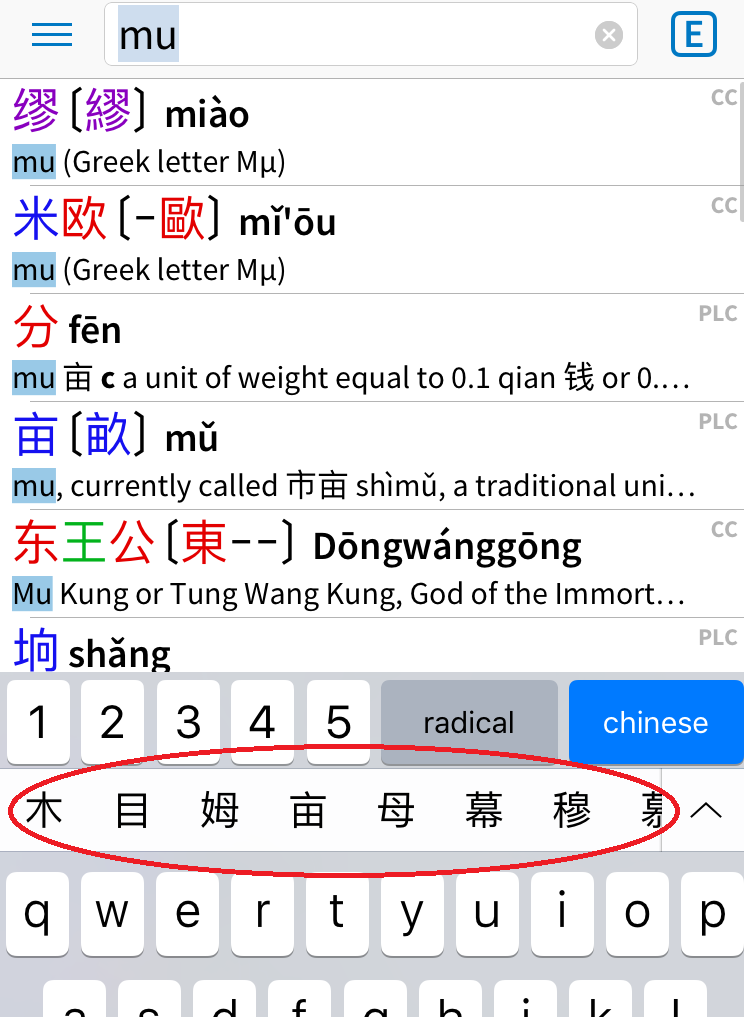
2. If you are using the  "简体拼音" keyboard mode, your phone will prompt you all the word that come with similar pinyin despite the tone difference.

When you key in "mu", the circled is the options of characters that is pronounced as "mu", in this case, the tone does not matter, it can be 1st, 2nd, 3rd, or 4th tone.  So you have to choose from that list before Pleco can provide the correct translation for you.

For example, the "mu" that you are looking for is “目”, Pleco will prompt you with the following result. If you notice, the circled part, those are list of characters that often come after the character  “目” and form their own meaning.
Try to click on one of them. I am clicking the first one “前”. And a new phrase “目前” is formed. it means at present; at the moment. Voila! New vocabulary word today.


3. Next, if you are using the "简体手写" keyboard mode, You will see the blank grey space underneath. That's where you should doodle/write. When I write the character, then it prompted me with a few selection to choose from that might have similar strokes. See the following example.


Once you choose the correct character that you would like to translate, it will provide you with a list of other characters that often come after it. You can choose to ignore it and just translate that one particular character, or you can choose one of the list to form a phrase and be one vocabulary richer than you currently are. :)


4. Last one is "繁體拼音", We will not be talking much about this. However, you should know that there are two types of Chinese character; traditional and simplified. As you can tell from the name, simplified Chinese is the simplified version, while the meaning remains the same, the characters have been simplified. See the difference when you input "rang" while using 繁體拼音 and 简体拼音.


Here is the screen that you will be prompted for the two different input. The character in te bracket (more complex) is the traditional character.

So the next time you encounter the word with the same format, with a character in the bracket, you know that it refers to the traditional Chinese character.

See some of the following example:

3 sets of words, with their simplified characters version and the traditional version with NO difference in meaning.

Before moving on, here is the things that you can do to explore and practice more the above:
1. Using the 简体拼音 keyboard and see the list of the words with the following pinyin "ma", "ta", "da", "shang", "san", "shan"

2. Using the 简体手写 and try to doodle the characters below and find out the meaning for each. If you want, see the possible phrases (2 characters of more) that can be formed using the following character.
马,大, 上, 山,伞,木

 3. using this 繁體拼音 mode and see the list of words for the following pinyin; "shuo", "sha", "hai", "tai yang", "feng".


Have you got the idea how the things work?

So answer the following question:
1. If you are in Taiwan, and you see a poster with Jacky Cheung's face on it and with his name "張學友" underneath it. How do you find out about the pronunciation of those words?

2. If you are watching CCTV channel in China and you see the word “中国”, what are you going to do to find out what the 2 words mean and how to pronounce it?

3. Show me 2 ways of translating words / phrases that you encounter in a beginner book that you have just bought from China, where normally characters will be accompanied by pinyin. Try these 3 phrases:  阳光 (yang guang), 木瓜 (mu gua),大人 (da ren)

Answers will be reavealed in next post, so you can check if you have got them right.

Happy Learning,
Linda Tan

P.S.
A bit of History:
June 9th, 2016 is Month 5, the 5th in Lunar calendar. It is known as “端午节” (duan wu jie) where people nowadays hold dragon boat festival and make dumpling to remember one of Chinese nationalist 屈原 qu yuan.


Tuesday, May 31, 2016

Pleco - Translating English to Mandarin - CHARS, WORDS, and SENTS Tabs

Let's continue... We are still looking at the things that we should pay attention to in Pleco, while we are translating words from English to Mandarin.

Last post, we were looking at all the things under the DICT tab.

In this post, we are going to look at the other tabs, that include CHARS, WORDS and SENTS tabs.

Today, try to key in "dog" in the search box. You will get the following screen, then you can implement what you have grabbed from the previous post on the DICT tab.

 Ask yourselves the following questions:
1. Do you see the Chinese character for dog?
2. Can you pronounce it? Just simply follow the sound when you press on the speaker.
3. Do you see the sample given? Although this example is showing you how people use it in an offensive manner, just keep it for your knowledge and not to use it when not necessary.
4. There is a new thing here, please look at the image above, under CC. you see the abbreviation M in bold? That refers to the measuring words for dog. In English we say "a dog", "an apple", "a bowl of soup" , in Bahasa Indonesia, we say "seekor anjing", "sebuah apel", "semangkuk sup". In Chinese, we can use either "zhi" or "tiao" to measure the numbers of dog. "Yi zhi gou" means one dog/a dog. So that's something new under DICT tab.


Moving forward, lets click on CHARS tab.

There are 2 drop down menus that say: "Radical" and "Component".
a. Radical
Radical is defined as the fundamental nature/root of something, in this case, the Chinese Character for "gou", dog. Most radicals are rooted from another character in Chinese. For dog it comes from this 犬, quan, which in Chinese it is another character that has the same meaning, dog.

In some cases, as this one, we do not write the radical exactly the same as the root word "犬", instead the form changes to the shape as you see in the circled part below.

Many other words has the same radical, such as, cat, monkey, lion, and many other animals. You can try to Pleco it later!

Please note that, there are radicals that when written in another chracacters, keep their original shape. For example,  灯  (deng) lamp. Its radical is 火. Do you that it keeps the original shape in the character 灯?

b. Component
Components refer to the parts of character. In Mandarin, there are some Chinese characters that are simple and stand on their own to form their own meaning (E.g. 人,手,一,十)and there are those which are more complex characters where they are formed by a few basic characters. For dog, it consists of 2 parts, the radical that we have seen before, and another character 句, when it stands on its own means "sentence".

The radical in a characters most of the time could help us guess what that particular character is trying to define or what the character relates to.

Here are the examples of radicals that shows the meaning of a word/character.
言 (yan) means speech. Some of the words that are formed using it as radical are; 语 (yu) language, 话 (hua) speech,说 (shuo) say,讲 (jiang) say,讯 (xun) ask, etc. As you can see most of them are related to "speech".

火 (huo) means fire。灯 (deng) lamp,烟 (yan) smoke,烧 (shao) hot/burn,煤 (mei) charcoal.

See how the Chinese characters  are formed? I will show you the many structures (结构)of a Chinese characters in a later stage.

So, when people say Chinese characters are not easy to write, I say "indeed it is difficult." However to make it easier, please try to break it down to small parts, extract the components out, it will be much easier that way, best it helps you to identify the meaning of the characters too.

Thus, basic is important. Normally, for a beginner, we will be exposed to easy characters, that has only 1 component in it, and from there, it grows to the more complex characters.

That's pretty much about CHARS tab. Moving on...

WORDS Tab

As you might have already figured out. Those are the common phrases where we can find the word 狗 (gou). It is divided into 2;

a. Words beginning where the 狗 is in the beginning of each phrases
b. Words containing where the 狗 can be found other than the beginning of the phrases. It can be in the middle, the third place, the fourth, and so on or at the end of the phrases.

Skim through it, see if any vocab may be useful for you. This is how we enrich our vocabularies, read more!

SENTS Tab
Under this tab it shows us the usage of word "dog" in the sentence. From the sample sentences, you will learn that word "狗" can have various meaning, not only "dog" as in human's best friend.

So, basically these are the things that you have to know about Pleco when you are translating English words to Mandarin. I hope you find this useful.

The next post will be brief post about translating Mandarin to English on Pleco.


Happy Learning,
Linda Tan