Showing posts with label pinyin. Show all posts

Tuesday, August 16, 2016

Lesson 8: Expressing Wants/Desire for something or to do Something


In English, we use "want" to express our need and desire to do something or for something. In Chinese we use 要 yào or 想 xiǎng. There are not much different in the usage. However, when you use 想 xiǎng, it shows more desire than just wanting for something. Also 想 xiǎng can only be followed by verb.

For example: I want to drink
we can say...

我要喝水
wǒ yào hē shuǐ

or... we can also say...

我想喝水
wǒ xiǎng hē shuǐ


As for this sentence: My younger brother want a bowl of rice.

We do not normally say:
我的弟弟想一碗饭
wǒ de dì di xiǎng yī wǎn fàn

we will say...

我的弟弟要一碗饭
wǒ de dì di yào yī wǎn fàn

When it comes to the negative form, we use "does/do not want" and translated as 不要 bù yào or 不想 bù xiǎng (which meaning is leaning towards: "do not feel like ..."

For example:
I do not want to drink
我不要喝水
Wǒ bù yào hē shuǐ

When you say:
我不想喝水
Wǒ bù xiǎng hē shuǐ

It means that "I do not feel like drinking water", slightly different meaning from "I do not want to drink water."


How about the following sentence?
My mom doesn't want a bowl of rice

Yup, because mom wants "something - noun" and NOT wants "to do something - verb", that's why it is more appropriate to use bù yào, instead of bù xiǎng

我(的)妈妈不要一碗饭
Wǒ (de) mā ma bù yào yī wǎn fàn


Try translating the following sentences:
1. I want to see your teacher
2. My elder brother wants a bike
(remember to include the measure word for bike! Identify it on Pleco)
3. Dad and mom want to go out tonight 
(Note: In Chinese, Adverb of time is used in the beginning of the sentence) 
4. My younger sister wants to eat spaghetti
5. My dog wants that ball!

Answer to be revealed in next post!

Regards,
Linda Tan


Tuesday, August 9, 2016

Lesson 7: Expressing Posession in Mandarin (Adult)

To show possession in English, we often use have/has or there is/ there are something.... 

In Mandarin, have/has is translated as 有 yǒu

For example:
I have younger brother
我有弟弟                  Wǒ  yǒu dì di

However, in English we can also use possessive adjective (such as, my, your, her, etc).

In Chinese, the character that shows possession is (de)

The owner + de + the possession
He has older sister, we say:
他有姐姐
tā yǒu jiě jie

or if we use possessive adjective, we can  also say:
His older sister
他的姐姐
tā de jiě jie

Example in sentence:
I have older brother
我有哥哥
Wǒ yǒ gē ge

Mr. Li is my older brother
李先生是我的哥哥
Lí xián sheng shì wǒ de gē ge

The negative form of have and has can be don't have or have not got / has not got. In Chinese, it is "没有" méi yǒu.

Furthermore, in English we knows about possessive pronouns (such as: mine, hers, theirs, yours, etc)
Look at how we do this in Chinese:
1.  I have an elder brother
一个哥哥

2.  That is my elder brother
那是我的哥哥

3. This is his elder brother,That is mine.
这是他的哥哥, 那是我的
(We do not have to mention "My elder brother" anymore, because, the first part of the sentence we have already introduced someone else's elder brother, so we assume that everyone knows that when I say MINE, in this context I am talking about "MY Elder Brother"

Another example:
That house is belong to Mr. Li
那个屋子是李先生的

which means
That's house is Mr Li's house
那个屋子是理想生的屋子

In order for you to be able to form more sentences to show your possession, first you need to know the Mandarin for things that you own, for example car, house, handphone and more.

Here are a few things that you might own, please translate it to Mandarin (feel free to add more):
1. House
2. Car
3. Pen
4. Dog
5. Cat
6. Handphone
7. Laptop
8. Children
9. Daughter
10. Son


Now you can try to translate the following simple sentences:
1. Ms Linda has an older sister
2. Her sister is Casandra
3. My dog is Blacky
4. Her house is big
5. Our father is Mr Chen
6. Their mother is Mrs Li
7. They have 2 dogs
8. That kid do not have a grandfather

Have a good day,
Linda Tan

Friday, August 5, 2016

Answers to Lesson 6

In Lesson 6, we learn about telling day and date. There are some exercises given at the end of the post. Check your answer here:

1. What date is the day after tomorrow?
hòu tiān shì jǐ hào?

2. The day after tomorrow is August the 4th
hòu tiān shì bā yuè sì hào

3. What day is yesterday?
 zuó tiān xīng qī jǐ?

4. Yesterday is Sunday
zuó tiān (shì) xīng qī rì

5. What date and month is 2 days ago?
qián tiān shì jǐ yuè jǐ hào?

6. 2 days ago was 31st of July
qián tiān sqī yuè sān shí yī hào


Listen to the following


Practice it everyday! Wake up in the morning and tell yourselves that:
Today is Monday, Yesterday is Sunday, Tomorrow is Tuesday, 2 days ago is Saturday, and the day after tomorrow is Wednesday.

Also... Today is Aug 2nd, Tomorrow is Aug 3rd, Yesterday is Aug 1st, and so on...

It will not take long, do it while you are showering, etc... In a month time, you will be very fluent in asking and telling day and date as well as in numbers! :)

Happy Weekend,
Linda Tan


Monday, July 11, 2016

Answer for Exerises in Lesson 1 (A)

Here is the answers for the 2 exercises on lesson 1 (A)

Exercise 1
The missing numbers are:
Fifteen (15)                 shí wǔ              十五
Sixteen (16)                shí liù               十六
Seventeen (17)            shí qī                十七
Eighteeen (18)            shí bā                十八
Nineteen (19)             shí jiǔ                十九

Exercise 2
Twenty Four (24)         èr shí sì               二十四
Twenty Five (25)         èr shí wǔ             二十五
Twenty Six (26)           èr shí liù              二十六
Twenty Seven (27)      èr shí qī                二十七
Twenty Eght (28)        èr  shí bā               二十八
Twenty Eight (29)       èr shí jiǔ               二十九

Thirty One (31)          三十一          sān shí yī
Thirty Two (32)          三十二         sān shí èr
Thirty Three (33)       三十三          sān shí sān
Thirty Four (34)        三十四           sān shí sì  
Thirty Five (35)         三十五          sān shí wǔ
Thirty Six (36)          三十六           sān shí liù
Thirty Seven (37)      三十七          sān shí qī
Thirty Eight (38)       三十八          sān  shí bā     
Thirty Nine (39)        三十九         sān shí jiǔ

If you notice, the only character that is changed is the first, When we are in 20ish, all start with 二 (èr), when we are in 30ish then we change it to 三 (sān).

I believe you can do the 40 - 99 yourself by now.

We will stop at 100 which is 一百 (yī bǎi

Hope you get all your answer right. :)

Happy Counting,
Linda Tan

Monday, July 4, 2016

Hanyu Pinyin - Part 4 - More Phonics

 Here are the phonics that you have been introduced before:
Single vowels: a, o, e, i, u, ü and
Consonants: b, p, m, f, d, t, n, l, g, k, h, j, q, x, zh, ch, sh, r, z, c, s, y, w

Other than the above, there a few more that you have to know and understand. As you can already see in the pinyin chart on Yabla's site, there are many of the remaining that I haven't covered. In fact, I am not going to cover all. I will show you the other basic pinyin that is formed by combining the 2 vowels, that is known as 双韵母 (shuāngyǜnmǔ) and sounds that come out from your nostril, known as 鼻韵母 (bíyǜnmǔ )

Let's first look at 双韵母 (Shuāngyǜnmǔ). It literally means double vowels. Here they are:
ai    ei    ui   
ao   ou
iu    ie    üe    er

Tips on pronouncing the above:
1. Pronounce the first alphabet (remember it is more to Bahasa Indonesia ABC than English ABC) and without stopping (no gap), followed by the pronunciation of the second alphabet.

2. Repeat the sound in a faster pace.

3. Again, it sounds almost the same like Bahasa Indonesia pronunciation. You do not have to memorize them all. Just try to pronounce it with the trick above (no. 1 & 2) and you should be able to get the correct pronunciation. Again, NO memorizing)

Let's see the video below (I am sorry, that you can only view this on your desktop).

Here is the implementation in spelling a word:

Remember! The spelling of the 2 vowels must be pronounce continuously without stopping. Treat "ao", "ei" as One phonic, not 2 separate phonics. Here is the difference if you spell it one by one with a gap in between, and this is not the right way to do it!


Here is how you use it in spelling a word!


More Example:

Try spelling the following on your own:
  1. k - āo
  2. x - i - ǎo (try spelling word with 3 syllables)
  3. t - uō
  4. l - uò
  5. j - üé
  6. m - ài
  7. q - iē
  8. l - óu
The last one from phonics is to know that there are certain phonics which sounds are produced from our nostril, known as 鼻韵母 (bíyǜnmǔ ). Here they are:

an  en  in  un   ün 
ang, eng, ing, ong


Let's see how to use it to spell a word:

With this, the basic things that you should know about Chinese Phonics are all covered. Here are a few important rules that you should know:
1. I mentioned that vowel is the one that should carry the symbol of intonation on top of them. It will be easy if there is only one vowel in a word. If there are more than one, such as in the word "shuoI", then you have to know where to appropriately place the small symbol for intonation.

In the first part of Hanyu Pinyin post, I asked you to memorize the vowel in the given order: a, o, e i, u, ü. It is for a reason. That order helps to decide who is going to wear the "crown".

Here is the rule:
a. If you see an "a" in the word, then "a" should definitely wear the crown (E.g. hǎo)
b. If you don't see an "a" then either "o" or "e" should wear it. "o" and "e" has never come together in a word (E.g. xiè, shōu)
c. However, if "u" and "i" come together, whichever that place a the back, then it should wear the crown. (E.g. shuǐ, xiū)

2. When 2 words with 3rd tone comes one after another, the first word should be pronounced as 2nd tone (while the writing have to be kept as 3rd tone "v")
Listen to the following:

3. When you see a word that comes without an intonation symbol, it is known as 轻声 (qīngshēng), literally means soft tone. It has to be pronounced softly and keep it short! See the following:


There are more rules that we should (not MUST) know, but I am not going to explain all of them here. It will be ongoing process. I will explain them when we see them during our learning. 

Now, you can practice reading the following sentences yourself:
  1. wǒ shì Linda                         I am Linda
  1. wǒ xué hàn yǔ                       I am learning Chinese
  1. tā shì shuí?                            Who is he/she?
  1. nǐ hǎo                                     Hello
  1. wǒ de mā ma                          My mother
  1. nà shì shén me?                     What is that?
  1. Ní hǎo ma?                             How are you? / Are you good?
  1. Wǒ xǐhuān chī pángxiè          I like to eat Crab
For the past 2 months you have been introduced to the tools and the very basic of Mandarin that will allow you to explore more yourselves. I want you to revisit every post about Pleco and Bihua.com to refresh your memory and also starting practicing the hanyu pinyin (Chinese phonics) from the single phonics to the one that we learnt above. 

To perfect your Chinese phonics, you can do the following:

Pick the things (noun) / activities (verbs) that you would like to know and translate them in Pleco. DO NOT play the speaker for now, look at the pinyin and start spelling and pronouncing them. Then for comparison, you can check the recorded audio to see if you have pronounced it right. Do not look at the sample phrases or sentences for now. If you get 80% of this right, then you might want to pick up a Mandarin book that comes with hanyu pinyin. And start reading short article. Best is to use the primary school kids' books (P1 or P2 books). Not only reading, you can start translating the short article to English and see if the story makes sense to you. :)

Happy Trying,
Linda Tan 

P.S. Here is the answer to the previous post exercise:
xī         mǎ       tā         chē      hé


Friday, July 1, 2016

Hanyu Pinyin - Part 3 - The 4 Tones

Moving forward, once you know how to spell the combination of phonics, then you have to get to know and master the 4 tones known in Mandarin.

Tone is known as 声调 ( shēngdiào ) in Chinese. There are 4 tones in Chinese and they are symbolized by the 4 small lines on top of one of the vowels.

To avoid confusion between the second and fourth sound (slash and backslash look alike), you can try to link the four lines to form letter "M" with the tail in front. If you can't form an M with the 4 lines, you have definitely written the second and fourth lines wrongly.

Each line represents how a word sounds.

The first line is flat, thus the sound produced by word with the first tone is flat, just like when a dentist ask you to open your mouth and say "ahhhh".

The second line has to be written from the left bottom to the right top (going up), because the sounds that are produced by words with second tone is going up.

The third line looks like letter 'v'. I always relate this to the sound of burping (short one!).

The fourth line has to be written from the left top to the right bottom (going down), because the sound it produces would be like the "aw!" sound that you make when a friend hit you, high pitch to low pitch.

Please listen to the following:

Listen to the second sound, I purposely drag it longer so that it is clear how the sounds go from lower to higher pitch. However, when we speak we normally do not drag the sound.

Let see how we use it in the spelling:

More sample spelling...


You should first work on perfecting the 4 tones for the 6 individual vowels.

āáǎà
ōóǒò
ēéěè
īíǐì
ūúǔù
ǖǘǚǜ

Then, you can start spelling a word that consists of 1 consonant + 1 vowel. You can try the following combination of phonics that form a word:


nā   ná   nǎ  nà


bō   bó   bǒ  bò


dē   dé   dě  dè


qī   qí   qǐ  qi


kū   kú   kǔ  kù

xǖ   xǘ   xǚ  xǜ


Match your answer with the spelling on this page

Tips and Trick!
Pronouncing the 3rd tone can be a bit tricky. Personally I think changing it a little works just fine. You can try to imitate the sound that you make when you burp (short one!) Listen to the (burping) sound in the video below and how we use it to pronounce actual words.


We are going to finish up pinyin, in my next post. As mentioned, pinyin will help you to read the translated English word in Pleco or any other dictionaries and maybe read books that come with pinyin (most beginner books do have pinyin). Also, once you know how to read/pronounce certain words or when you hear someone say something and able to spell the pinyin out, it will enable you to look up the meaning of the words in Pleco much faster. All in all, pinyin is the basic tool that will allow you to explore more about the language yourself.

Try the following, write down the pinyin and the tone of the word that you hear. Answer will be revealed in the next post.

Feel free to comment or ask questions!

Happy Spelling,
Linda Tan


P.S. I have not found a way to make the video work on hand gadget (on my iPhone), so the videos above can only be viewed on a desktop or laptop.
For first timer, please go back to the very first post to start learning Mandarin. Here it is. It is to get to know what you need along the way.


Thursday, June 23, 2016

Introduction to Hanyu Pinyin - Part 1

Hanyu Pinyin is the romanization system of Chinese characters, or known as the Chinese Phonics. As I have mentioned before, the pronunciation is closer to our Bahasa Indonesia pronunciation than English. We read "mang", "shang", "lang", "ai", "mei", "fa" just like how we read it in Bahasa Indonesia, the only thing that will differentiate them with Bahasa Indonesia is the intonation. As for your reference, why I said it is different from English, because letter "a" in Chinese is read as "a" as in word "aku" or "father". We do not read the letter "a" as "ei" as how we spell in English alphabets and how it sounds in the word "say".

Another example, "lang" in Chinese doesn't sound like the first syllable of "language", instead, we read it as in the Bahasa Indonesia word "langsung"

There are 6 single vowels in Chinese. They are a, o, e, i, u, ü. Please try to memorize them in this order, because it will help in the future. Again, the order is:

a, o, e, i, u, ü.


Here is how they are pronounced

If you notice the only difference with English and Bahasa Indonesia is that in Chinese there is an additional vowel that is written as u with 2 dots on top. on your phone, you can use the letter "v" to represent this letter ü.

The next part is sheng mu 声母 or we can call them as the consonant in Mandarin.

Here is the list of sheng mu
b    p     m   f

d    t      n    l

g    k     h   

j     q     x

zh  ch   sh  r

z     c    s

y    w

I will want you to familiarize yourselves with the above pinyin for now. Try your very best to memorize it in the order given. Here is the compilation of the mentioned Chinese phonics / pinyin we learn above:


Once you are okay with it, read the following:

a o e i u ü b p m f d t n l g k h j q x zh ch sh r z c s y w

The sound of zh and z are almost the same. The difference is the shape of the mouth and position of your tongue.

For zh ch sh r, you have to fold your tongue and shape your mouth as when you pronounce the first syllable of "SH-ape"

For z c s, you have to keep your tongue flat down and shape your mouth as when you pronounce "cheese"

Once you know how each of the alphabet is pronounced in Chinese, then try to pronounce the following. (they are random!)

j, g , m , i ,  c ,  f

zh , b , s , y , k ,  p 

t, l, x, d, q , o

z, sh, r, u, w

ch, a, e  , n , h


See if you get them right. Here is the answer:


Cross check your answer...

Only when you can identify each of the alphabet with the correct sound when they appear randomly, then you can start "spelling" word.

There are actually other pinyins that we have to get ourselves familiar with (such as the double vowels, ei, ai, ou... etc), however, the above are the basic. Let's take it step by step. With this alone, you can already read quite a bunch of words. Next post we will try to apply this to words with simple pinyin such as: ma, ta, le, ke, he, cha, she, pa, ne, me, sha, etc.

There are a few rules that you have to know (such as "ri" is read as "re" in "resah", etc), but not now...

For now, familiarize yourselves with the above.

Happy Spelling,
Linda Tan

P.S. There is high chances that the video above is not supported in ios. It definitely doesn't work on my iPhone (not sure about android), however, it works fine on my laptop. So if you can't play the video (that shows you how to pronounce the phonics), then please check this video on Youtube. Click here

If you want to master the above first and take it step by step, then you can stop the video when it reaches the minute of 1:50. However, if you would like to explore more yourselves, then feel free to watch the whole video.


Tuesday, June 7, 2016

Pleco - Translating Mandarin to English - the Keyboards

Knowing how to use Pleco to translate the English word that you need to use to Chinese is good. However, what if you encounter a letter in Chinese and do not know what it means? So it is equally important to know how to use Pleco to translate Mandarin to English.

When translating Mandarin to English, you first need to do the following setting to your phone. Although it is possible for you to key in the pinyin (possible for you to use the same English "abc" keyboard), there will be a time where you are clueless on how to pronounce the character that you are seeing. In this case, it is impossible for you to key in the pinyin, instead you have to key in the Chinese character. In order to enable you to do that, you have to have special keyboard for it. Here is how.

a. First, go to setting and Choose "General" you will be prompted with the following screen
b. Then, choose "Keyboards", you will see the following and choose the first option of "Keyboards"

c. You will see the following screen, Choose "Add New Keyboard" and pick "Chinese (Simplified) - Handwriting and "Chinese (Simplified) - Pinyin. These are the two that you will use often. However, Macau, Hongkong and Taiwan are still using the traditional characters (those with more strokes) so just to be prepared, you can also add "Chinese (Traditional) - Pinyin" keyboard.


Once you are finishing adding keyboard, here is how it works on your phone. When you press and hold the "Globe" icon, you will be prompted with the following option (see the bottom left corner):

1. English (US) - where your input will be treated as English spelling
2. 简体拼音 (jian ti pin yin) - Chinese (simplified) - Pinyin - where your pinyin input will prompt you all the results in Simplified Chinese Character
3. 简体手写 (jian ti shou xie) - Chinese (simplified) - Handwriting - Where you can "doodle" or write the character that you are about to translate.
4. 繁體拼音 (fan ti pin yin) - Chinese (Traditional) - Pinyin - where your pinyin input will prompt you all the results in Traditional Chinese Character.

See the following example:
1. If your keyboard is using the first (English (US)) keyboard mode, then Pleco will treat the input as English spelling or pinyin

"Dai" input is treated as pinyin, because there isn't word "dai" in English.

"Day" is treated as an English word, as there isn't "Day" in Chinese pinyin.


However if you are in "C" mode (see the blue box at the right corner), then the input will be treated as Chinese Pinyin. Thus, when you key in "Day", the following screen is prompted.

2. If you are using the  "简体拼音" keyboard mode, your phone will prompt you all the word that come with similar pinyin despite the tone difference.

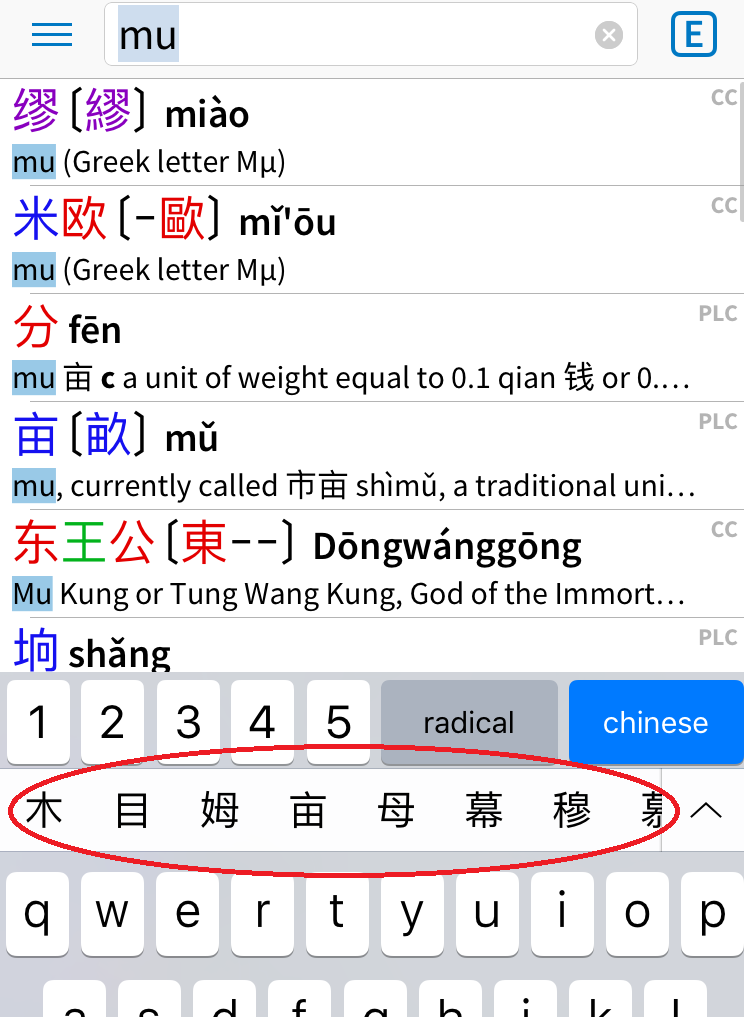
When you key in "mu", the circled is the options of characters that is pronounced as "mu", in this case, the tone does not matter, it can be 1st, 2nd, 3rd, or 4th tone.  So you have to choose from that list before Pleco can provide the correct translation for you.

For example, the "mu" that you are looking for is “目”, Pleco will prompt you with the following result. If you notice, the circled part, those are list of characters that often come after the character  “目” and form their own meaning.
Try to click on one of them. I am clicking the first one “前”. And a new phrase “目前” is formed. it means at present; at the moment. Voila! New vocabulary word today.


3. Next, if you are using the "简体手写" keyboard mode, You will see the blank grey space underneath. That's where you should doodle/write. When I write the character, then it prompted me with a few selection to choose from that might have similar strokes. See the following example.


Once you choose the correct character that you would like to translate, it will provide you with a list of other characters that often come after it. You can choose to ignore it and just translate that one particular character, or you can choose one of the list to form a phrase and be one vocabulary richer than you currently are. :)


4. Last one is "繁體拼音", We will not be talking much about this. However, you should know that there are two types of Chinese character; traditional and simplified. As you can tell from the name, simplified Chinese is the simplified version, while the meaning remains the same, the characters have been simplified. See the difference when you input "rang" while using 繁體拼音 and 简体拼音.


Here is the screen that you will be prompted for the two different input. The character in te bracket (more complex) is the traditional character.

So the next time you encounter the word with the same format, with a character in the bracket, you know that it refers to the traditional Chinese character.

See some of the following example:

3 sets of words, with their simplified characters version and the traditional version with NO difference in meaning.

Before moving on, here is the things that you can do to explore and practice more the above:
1. Using the 简体拼音 keyboard and see the list of the words with the following pinyin "ma", "ta", "da", "shang", "san", "shan"

2. Using the 简体手写 and try to doodle the characters below and find out the meaning for each. If you want, see the possible phrases (2 characters of more) that can be formed using the following character.
马,大, 上, 山,伞,木

 3. using this 繁體拼音 mode and see the list of words for the following pinyin; "shuo", "sha", "hai", "tai yang", "feng".


Have you got the idea how the things work?

So answer the following question:
1. If you are in Taiwan, and you see a poster with Jacky Cheung's face on it and with his name "張學友" underneath it. How do you find out about the pronunciation of those words?

2. If you are watching CCTV channel in China and you see the word “中国”, what are you going to do to find out what the 2 words mean and how to pronounce it?

3. Show me 2 ways of translating words / phrases that you encounter in a beginner book that you have just bought from China, where normally characters will be accompanied by pinyin. Try these 3 phrases:  阳光 (yang guang), 木瓜 (mu gua),大人 (da ren)

Answers will be reavealed in next post, so you can check if you have got them right.

Happy Learning,
Linda Tan

P.S.
A bit of History:
June 9th, 2016 is Month 5, the 5th in Lunar calendar. It is known as “端午节” (duan wu jie) where people nowadays hold dragon boat festival and make dumpling to remember one of Chinese nationalist 屈原 qu yuan.